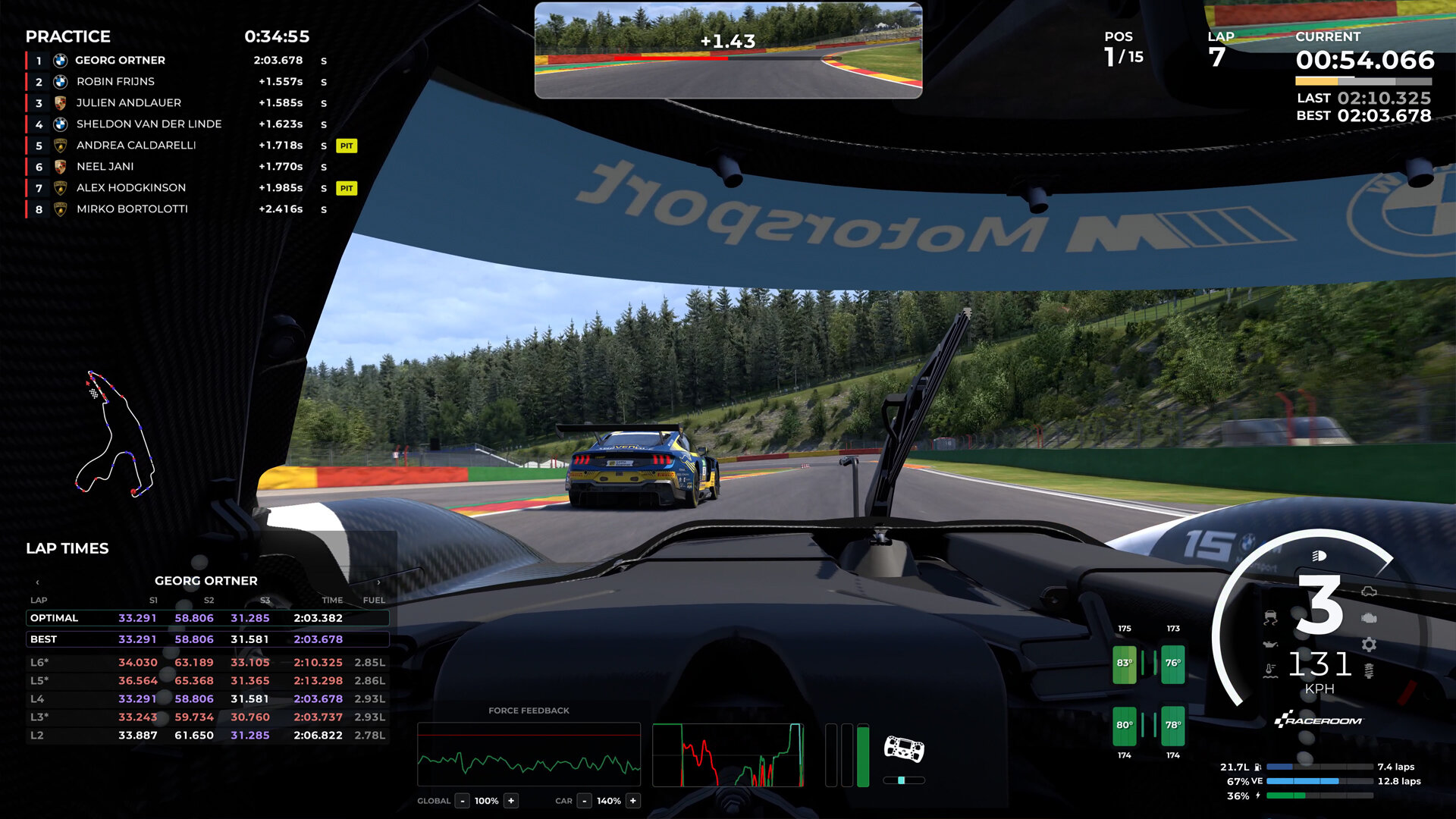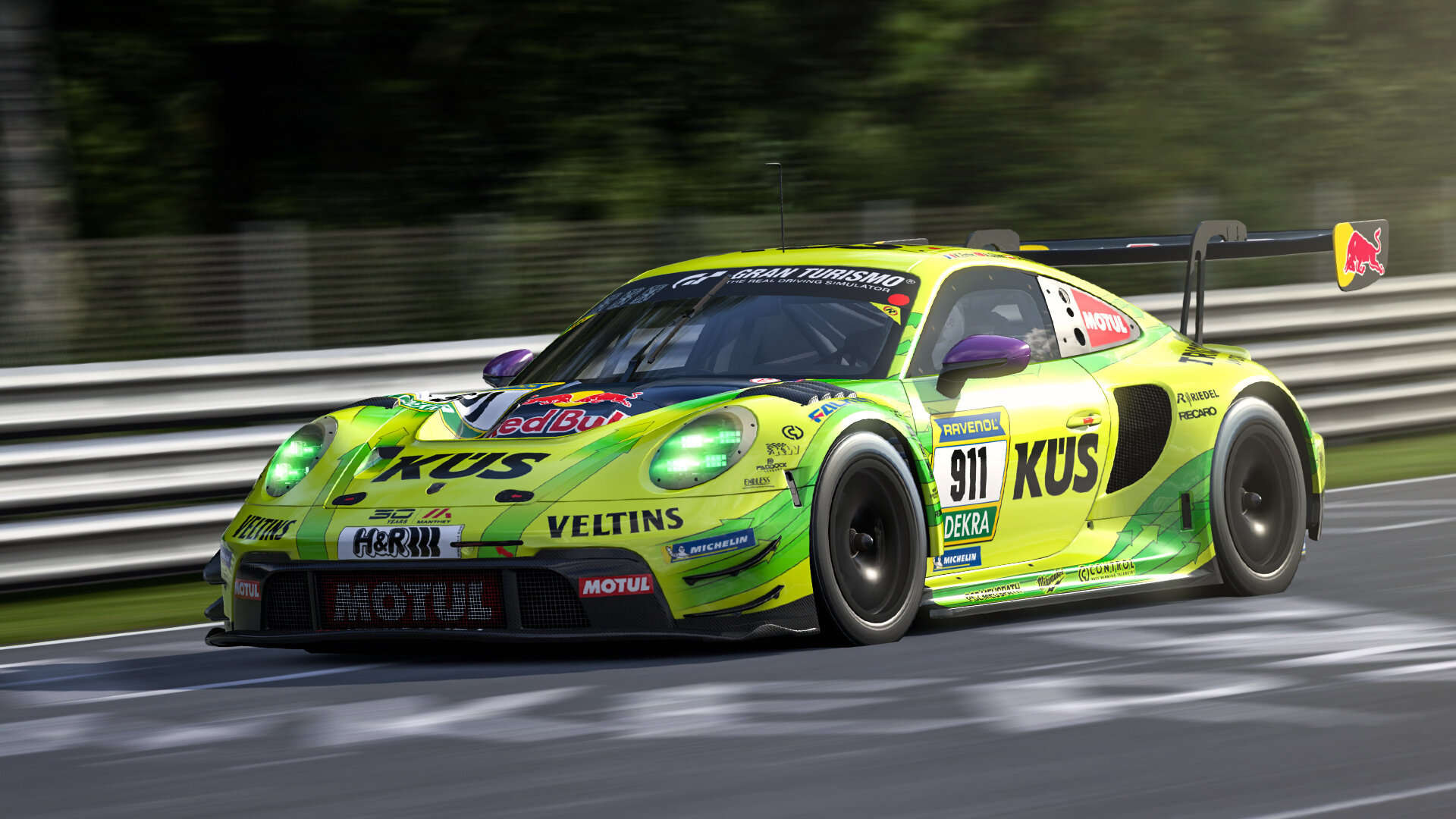

L'aggiornamento di oggi introduce in RaceRoom una vasta selezione di nuovi contenuti legati al motorsport storico: nuove vetture per le categorie Group 2 e Super Touring, circuiti storici inediti, una nuova cronoscalata e una versione aggiornata dell'Hockenheimring.

Tuttavia, questo aggiornamento va ben oltre la semplice aggiunta di nuovi contenuti.
Dietro le quinte, sono state abbandonate alcune delle tecnologie più datate di RaceRoom, sostituendole con sistemi che pongono basi decisamente più solide per il futuro. Tra le novità figurano un sistema di menu e un'infrastruttura backend completamente rinnovati, importanti modifiche al Force Feedback, una procedura di partenza lanciata manuale, prestazioni ottimizzate, display di bordo aggiornati, il ritorno del monitoraggio delle statistiche e molto altro ancora.
Ulteriori dettagli sono disponibili sulla pagina Steam.
Correte a scoprire le novità riguardanti il Force Feedback: modello di contatto degli pneumatici aggiornato, servosterzo ricostruito, modifiche al giroscopio e nuove impostazioni.
QuoteWith improvements to tyre contact physics and a rebuilt power steering system you’ll feel more of what the tyres and steering rack are doing. New settings give you more control over how that feedback reaches your wheel. Below, we explain what’s changed and walk you through the updated settings to help you get started.
General Improvements:
Tyre Contact Model Improvements: The contact model now takes the whole shape and movement of the tyre contact patch into account, and evaluates it using the exact polygon shapes it is touching. This results in a much more consistent handling of complex geometry like kerb edges or sausage kerbs, and also improves two-wheeling and rollover behaviour. For the FFB, this means fewer noisy artifacts from poorly handled complex geometry, and a more precise FFB reaction to the surface you are driving on.
Physics Loop Optimisations: Our physics calculations run at a fixed update rate of 400 Hz, which is guaranteed by doing multiple physics ticks in one logic loop to catch up if the CPU is struggling. This ensures the physics behaves the same for everyone and in every situation. However, the FFB output rate is still tied to the logic loop update rate, which would previously slow down significantly in large grids, significantly degrading the FFB signal and delay. We have optimised many parts of the logic loop so that most systems should be able to keep it running at the full 400 Hz in almost any situation. Only in massive 100 car grids it might slow down slightly, but still remain fast enough to not degrade the FFB in any noticeable way.
Simplified wheelbase communications: Our FFB now only ever uses one DirectInput effect to output the FFB to your wheel. Before this, the game was opening and updating many different DI effects at the same time, potentially causing extra delay and other random issues. This new method is the modern industry-standard, so this should hopefully help improve wheel compatibility across the board.
Summary of FFB changes:
Fixed a significant error in our calculations of the gyroscopic effects of the front wheels. This previously added a lot of extra constant steering weight while cornering, which ends up drowning out the dynamic and detailed forces coming from the tyre contact patch. This old gyro effect did also have some benefit for car control in slides and makes the FFB more tame and stable, so we added a gyro effect slider to add some or all of this effect back to get close to the previous FFB feel if you liked it. We recommend giving the new feel a good try before trying this slider though, as it really is a big upgrade in terms of details and car dynamics.
Completely rebuilt power steering system with support for engine-driven hydraulic, electro-hydraulic, and fully electric power steering systems. The power steering is not a simple scaling of the FFB forces, it is a transient system that reduces strong constant cornering forces, while letting fast details and oversteer snaps through. This retains and even enhances the dynamic feeling of the steering, without having to crank up the FFB Strength. Also added a new option to run power steering to cars that originally don’t have it, which can improve the FFB a lot on those cars, especially for lower-end wheels.
Properly modelled steering rack types: different levels of friction from very old worm box racks, to modern, purpose built racing racks.
Added smoothing slider: Filters out any unwanted high frequencies from the FFB, can eliminate a grainy feeling at low settings and tone down sharp hits from kerbs or bumps at high settings.
Added Gyro Damping Slider: Which exaggerates the existing gyroscopic stabilisation of the tyres, to improve stability of the wheel on straights.
Fully physics-based stationary and low-speed FFB: The stationary friction is no longer an added effect. Now it is fully modelled as the low speed tyre friction and tyre twisting forces, resulting in a much more consistent and realistic transition from standstill to racing speeds. Note that this means that the steering can be extremely heavy when standing still, especially with brakes held and engine off (no power steering). This is realistic, and reduces very quickly as the tyres roll even at crawling speeds. But the stationary friction slider can help reduce it if you prefer it to be lighter.
Added road noise slider: A substitute for the general vibrations you feel when driving in a real car, translated to the FFB signal.
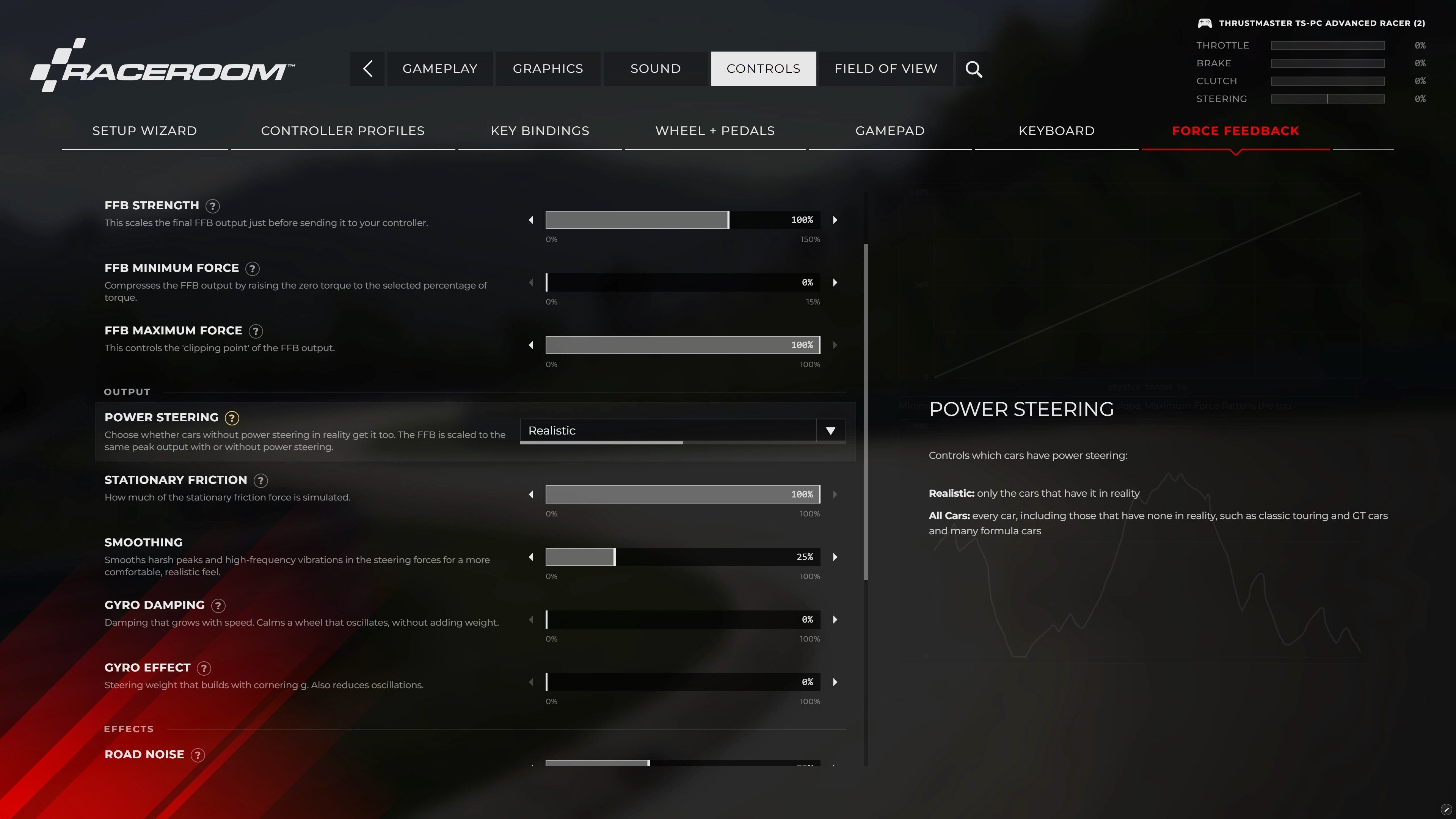
Quick guide on the in-game FFB settings menu:
Steering Rotation Mode: Auto if supported, make sure ‘Maximum Steering Rotation’ matches your wheel driver setting if set to Manual
FFB Strength: 100% recommended, lower if too strong
Smoothing: Off or low for non-DD Wheels. 10-25% reduces graininess, 50-75% reduces kerb/bumps. High values add delay, worsen oscillations
Power Steering: ‘All Cars’ recommended, Realistic only for pure authenticity on strong wheels
FFB Minimum Force: Only ever use on lower-end wheels with a dead zone
FFB Maximum Force: Make sure this is higher/equal to FFB Strength, to avoid clipping
Stationary Friction: 100% is realistic, set lower for preference or standstill oscillations
Gyro Damping: 0% is realistic, increase to reduce hands-off oscillations
Gyro Effect: 0% is realistic, increase to add extra feedback for rotation of the car
Road Noise: Dependent on wheelbase and preference, try what you like
Engine Vibrations: Dependent on wheelbase and preference, try what you like
Gearshift Effects: Dependent on wheelbase and preference, try what you like
External Wheelbase Driver Settings: Make sure rotation is set up correctly. Recommended to keep wheelbase filters minimal, try in-game smoothing and damping first if needed.